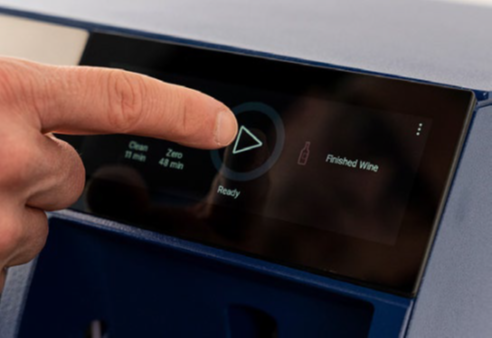
WineScan™ 3 and WineScan™ 3 SO2 solutions provide an all-new analytical platform for rapid, multi-parameter wine analysis.
Accurate data when it is needed
Outstanding reliability built on the unique WineScan calibration database representing reference data across seasons, wine types and regions. Subsampling technology captures the data required for highly representative results. Multiple parameters delivered in 30 seconds or in 2 minutes, if free and total SO2 is included.
Results that just keep on flowing
Robust flow system and SO2 analysis ensures that you can test more with less maintenance. Automatic instrument standardization maintains top performance. An autosampler option can deliver up to 130 tests per hour, unattended.
More time for winemaking
Use less time getting results and more time using them to improve wine quality. Highly consistent results cut the need for replicate measurements to confirm the validity. Software and connectivity enable unprecedented levels of support while keeping valuable analysis data safe, traceable and accessible.
Sample type
Must, must under fermentation, finished wine.
Ready-to-use analytical models
Models cover over 30 key quality control parameters, including free and total SO2
Technology
Fourier Transform Infrared Spectroscopy (FTIR). For SO2 analysis, SO2 gas is released from the sample and the gas is subsequently scanned using UV light.
Technical specification
Parameters Ranges within product type* |
|||||
| Components | Unit | Must | Must under fermentation | Finished wine | Comments |
| Alpha amino nitrogen | mg/l | 0-460 | Reference method: NOPA Used for calculating YAN |
||
| Ammonia | mg/l | 0-300 | Used for calculating YAN | ||
| Citric acid | g/l | 0-5.4 | 0-1.0 | ||
| CO2 | mg/l | 0 - 2800 | |||
| Density | g/ml | 1.0200- 1.2500 | 0.9900 - 1.1400 | 0.9800 -1.1900 | Density for must can be presented with other units, i.e. Babo, Baumé, Oechsle. The model can be converted to such unit using calculated component feature and right formula. |
| Ethanol | % Vol. | 0 - 19.0 | 0 - 19.0 | 0 -19.0 | |
| Extract | g/l | 0-300 | |||
| Fructose | g/l | 0 - 170 | 0 - 137 | 0 - 170 | |
| Gluconic acid | g/l | 0 - 9.0 | 0 - 5.7 | ||
| Glucose | g/l | 0 - 200 | 0 - 138 | 0 - 90 | |
| Glucose + fructose | g/l | 0 - 390 | 0 - 260 | 0 - 265 | |
| Glycerol | g/l | 0 - 12.0 | 0 - 21.0 | ||
| Lactic acid | g/l | 0 - 4.3 | 0 - 4.0 | 0 - 7.5 | |
| Malic acid | g/l | 0 - 26.0 | 0 - 7.3 | 0 - 6.3 | |
| pH | 2.4 - 4.6 | 2.8 - 4.3 | 2.8 - 4.4 | ||
| Potassium | mg/l | 0-5300 | |||
| Reducing sugar | g/l | 0 - 430 | 0 - 259 | 0 - 200 | |
| Sorbic acid | mg/l | 0 - 940 | |||
| Tartaric acid | g/l | 0 - 16.0 | 0 - 8.1 | ||
| Total acidity by end point pH 7.0 | g/l | 0 - 25.0 | 0 - 13.0 | 0 - 7.6 | Expressed as sulphuric acid |
| Total acidity by end point pH 8.2 | g/l | 0 - 39.0 | 0 - 20.3 | 0 - 12.8 | Expressed as tartaric acid |
| Total polyphenols | 0 - 120 | ||||
| Total soluble solids | g/100g(°Brix) | 16 - 30 | Total soluble solids for must can be presented with other units, i.e. g/L sugar. The model can be converted to such unit using calculated component feature and right formula. | ||
| Volatile acidity | g/l | 0 - 2.3 | 0 - 2.0 | 0 - 1.7 | Expressed as acetic acid |
Parameters Ranges within product type* |
|||||
| Options | Unit | Must | Must under fermentation | Finished wine | Comments |
| Alpha amino nitrogen | mg/l | 0 - 350 | Part of YAN for must under fermentation package | ||
| Ammonia | mg/l | 0-300 | Part of YAN for must under fermentation package | ||
| Tannin by BSA(Bovine Serum Albumin) | mg/l* | 0 - 1100 | Part of tannin package | ||
| Tannin by MCP (Methyl Cellulose Precipitable Proteins) | mg/l** | 0 - 3700 | Part of tannin package | ||
| Free SO2 | mg/l | 0 - 75 | 0 - 100 | ||
| Total SO2 | mg/l | 0- 130 | 0 - 250 | ||
| A420 nm | 0 - 1.0 0 - 2.5*** |
Included with color module | |||
| A520 nm | 0 - 1.2 0 - 3.5*** |
Included with color module | |||
| A620 nm | 0 - 0.3 0 - 1.4*** |
Included with color module | |||
| Other parameters | Contact your local FOSS office. | ||||
*) Catechin equivalent
**) Epicatechin equivalent
***) Wide range with reduced performance
Instrument specification
| Sample capacity | Manual: 120 samples per hour Autosampler: 130 samples per hour SO2 : 27 samples per hour |
||
| Sample volume (finished wine) | 5.5 mL for manual. 9 mL for autosampler | ||
| Sample preparation | Clarification by filtration or centrifugation. Particle size less than 25 μm. | ||
| Sample temperature | 10 °C to 35 °C | ||
| Power supply | 100 - 240 VAC ±10%, overvoltage category II, pollution degree 2, 50/60 Hz. | ||
| Power consumption | 400 VA | ||
| Ambient temperature | 10 °C to 35 °C | ||
| Relative humidity | < 93% RH | ||
| Altitude | < 2000 m | ||
| Vibration | Place the WineScan 3 on a stable bench free of vibration | ||
| Weight | 43 kg (+10 kg with SO2 ) |
||
| Dimensions (W x D x H) | 750 x 450 x 408 mm | ||
| Bench space (W x D) with PC | 1300 x 55 cm operated with an external PC | ||
| Minimum space between WineScan™ 3 and walls |
20 cm | ||
| Maintenance | |||
| Cleaning | Automatic and programmable | ||
| Instrument self-test | Automatic, integrated (additional test sequences available) | ||
| Options | |||
| Color module | Built-in or add on later | ||
| SO2 module | Built-in or add on later | ||
| Autosampler (external, add later) |
Power supply | Dimensions (W x D x H) | Weight |
| 100 - 240 VAC ± 10% 50 - 60 Hz ; 1,04 A Autosampler input: 24 V DC; 3,33 A |
62 × 33 × 59 cm (with sample probe, cables and tubing mounted) |
11,7 kg |