Tecator Line Digestion units allow fully automated digestion for convenient, safe and flexible Kjeldahl analysis. Two way PC communication supports traceability and GLP. Capable of handling eight or twenty tubes in volumes of 100 ml, 250 ml or 400 ml.
Efficient and cost-effective operations
Smooth operations save chemicals, energy, labour, space and time. FOSS digestors, with integrated programmable controllers, can be combined with a range of accessories. Efficient fume containment is provided through an optional exhaust and fumes can be removed via the optional scrubber.
Flexible management software
A wide range of applications can be downloaded from the database. Up to 254 applications can be stored in the digestor, of which half can be standard FOSS format and half can be user defined. Each application can control up to 23 steps including all temperatures; ramp and time; lift and scrubber steps.
Application support
The systems come with extensive application support and are compatible with FOSS Kjeldahl distillation units as well as other distillation units.
Sample types
Raw materials and finished products in food, feed, agriculture and related matrices
Water and wastewater and a wide range of industrial compounds
Parameters
Kjeldahl digestions, chemical oxygen demand and other reflux chemistries, trace metal analysis by AAS or ICP instruments
Accessories
Lift and racking system, exhaust manifolds and scrubber
Consumables
Kjeltabs, 100 ml, 250 ml and 400 ml tubes
Technology
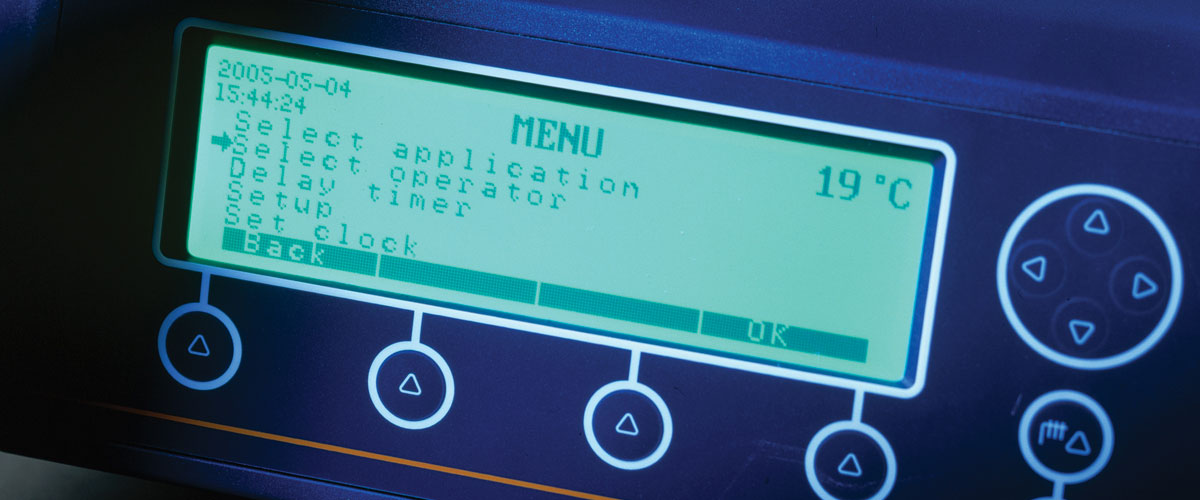
There are two separate software systems in Tecator Line digestors. The embedded software controls all necessary functions of the digestion system on a routine basis. The PC application software, delivered on USB, is a system management software which enables default values to be modified according to the needs of the authorised user.
To process different types of samples a wide range of applications can be downloaded from the database included on the USB. Up to 254 applications can be stored in the digestor at any one time, of which half can be standard FOSS format and half can be user defined. Each application can control up to 23 steps including all temperatures; ramp and time; lift and scrubber steps.
The software supports Good Laboratory Practice (GLP) routines and accreditation procedures. Data for date, time, temperature, application used, operator, batch number, and ID number are constantly logged. The 32 most recent data logs can be stored in the digestion unit. All this information can be transferred to a PC for ar-chiving and can generate up to seven different reports. Original FOSS applications cannot be changed. They can be adapted and saved as different files or the user can design their own applications. To prevent unauthorised changes, and comply with GLP routines, the software is password protected at different authority levels.
Accessories
Lift system
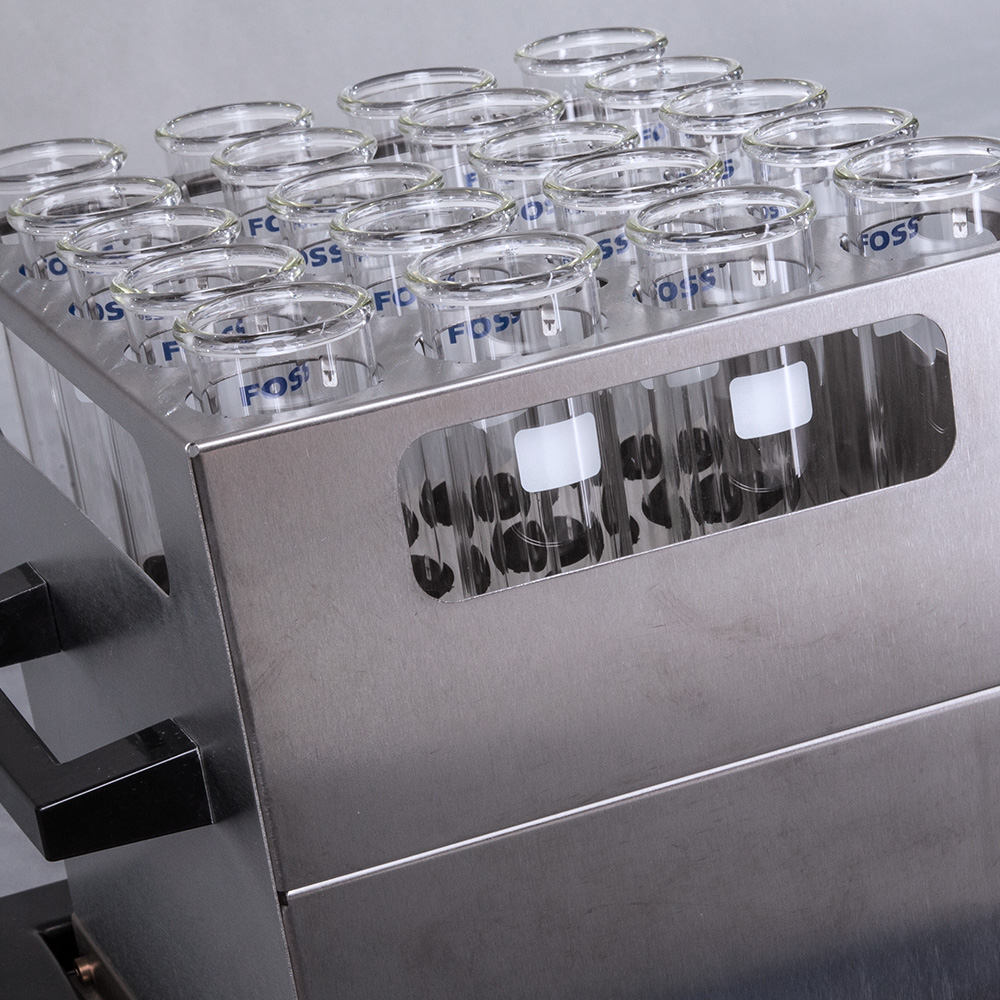
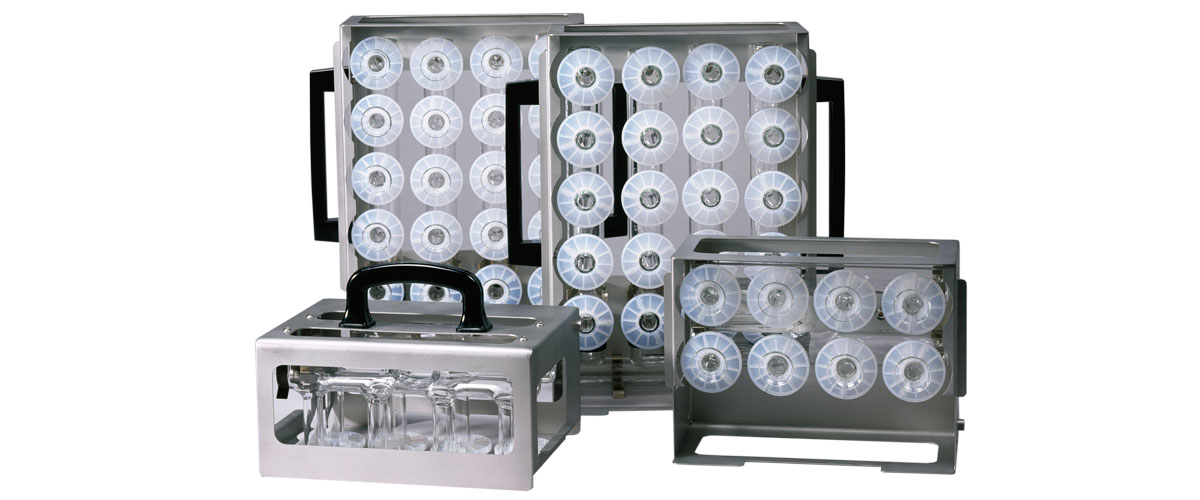
The lift system facilitates highly automated procedures, eliminating heavy and risky handling of hot chemicals. Valuable bench space is saved, as the tube rack and exhaust manifold are positioned above the digestor. A tube rack with 8 or 20 tubes is placed in the lift. The application selected then fully controls the entire process. The exhaust manifold docks automatically with the tube rack as they move down into the preheated digestor; and the scrubber, if connected, starts. The scrubber capacity is automatically adjusted during the cycle to contain fumes and minimise acid losses. When the digestion is completed the combined tube rack and exhaust manifold move to the cooling position with the scrubber still running until no further fumes are evolved. An adjustable audible signal in the digestion unit indicates “cycle over”. To avoid any spillage a drip tray, supplied with the exhaust manifold, is inserted underneath the exhaust manifold when it is separated from the tube rack after cooling.
Rack system
When the rack system is used in place of the lift system the typical procedure is as with the lift system with the exception that the combining/separating of tube rack and exhaust manifold and the movement to the cooling position is performed manually when the signal is heard. The application selected controls all other functions as with the lift system.
Fume removal and containment systems exhaust manifolds
Many digestion applications, e.g. Kjeldahl, produce fumes that are unpleasant and corrosive. Exhaust manifolds designed for each digestor facilitate fume removal and containment and are strongly recommended for use with all digestion procedures. The cost of replacement of a fume cupboard which has been corroded by inefficient fume handling is very much greater than the relatively low cost of an approved exhaust. Whilst many users choose to operate integrated systems in the open laboratory, we strongly recommend the use of both exhaust systems and fume cupboards for these operations. This is simply Good Laboratory Practice (GLP) and avoids conflict with local Health & Safety (H&S) requirements.
The exhaust manifolds should be connected to the water aspirator supplied, or to a suit-able scrubber.
Scrubber
Where water is a scarce or expensive commodity, or simply when a higher level of automation is desired, the water aspirator should be replaced with an efficient scrubber unit. Exhaust manifolds and scrubber units which require an external water source are subject to variation in vacuum efficiency due to fluctuations in local water pressure.
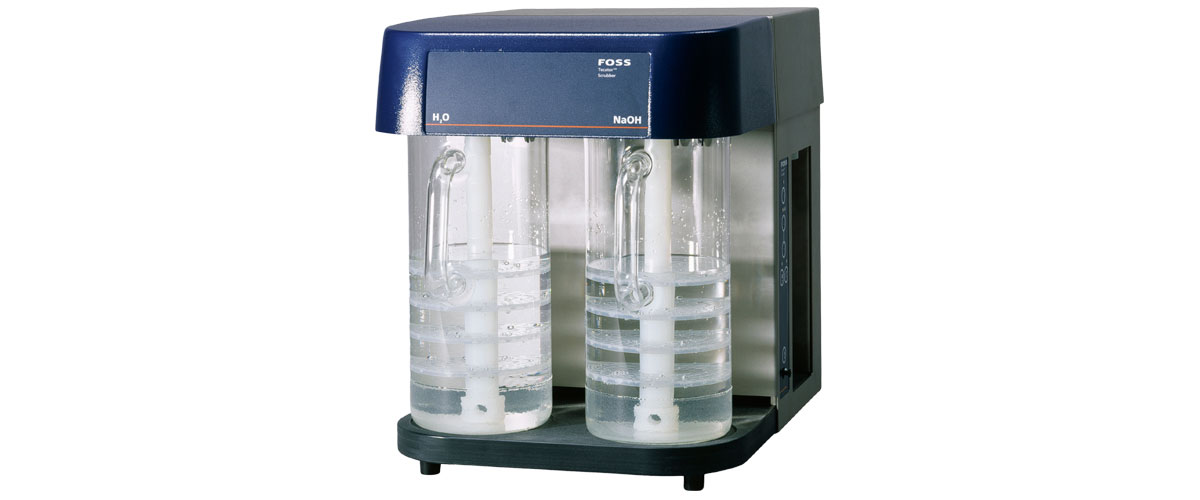
The compact bench top Tecator Line Scrubber 2501 is self contained and is therefore unaffected by water supply issues. During digestion moist, acidic fumes from the connect-ed exhaust are drawn through the scrubber. Acid vapours are first condensed and diluted in a large acid trap.
Any residual fumes are collected, washed and neutralised before passing through a second small acid trap which protects the vacuum pump in the event that the scrubbing agents are exhausted. The cleaned air is then vented via a tubing outlet. In the interest of GLP and H&S this venting tube should be directed into a fume cupboard. When the scrubber is connected to the lift or rack system the program will fully control the function including switching from high to low aspiration settings.
Reflux heads
When a digestor is used for reflux chemistries, such as Chemical Oxygen Demand (COD), a reflux head connected to a suitable cold water supply should be used in place of the exhaust manifold. Reflux heads are conveniently mounted in handling racks which match the tube rack in the digestion unit.
The ball jointed condensers are designed for use with ball jointed digestor tubes. The reflux heads are compatible with lift, rack and Labtec Line systems.
Digestion tubes
To suit different applications and manual/automatic handling systems, tubes for the digestion units are available in three sizes (400 ml, 250 ml and 100 ml) and three shapes. Straight sided tubes are recommended for the majority of digestion applications. Volumetric tubes with a constriction at the neck are recommended for applications where the digestate requires dilution to a fixed volume before analyses such as FIA, SFA, and AA etc.
Ball jointed tubes, available in 250 ml size only, are required for reflux chemistries using the reflux condenser heads. The larger 250 ml straight sided tubes are recommended for Kjeldahl, as they can hold samples of widely varying sizes. Samples of heterogeneous ma-terial often need to be fairly large to ensure that they are representative. There is no lower limit of sample size in the 250 ml tubes; they simply allow greater flexibility for most types of samples. The 100 ml straight sided tubes can be used where the material is homogene-ous and small samples are fully representative or where they are specified by the approved method. A special 400 ml tube which fits in 250 ml systems is designed for handling large liquid volumes, typically 50 or 100 ml in water and beer applications.
Kjeltabs
A salt, to increase the boiling point, and a catalyst, to increase the speed of reaction, are used for Kjeldahl digestions. As a convenient way to obtain the correct dosage, FOSS supplies Kjeltabs – tablets containing potassium sulphate and a catalyst (copper, selenium, or copper/titanium). Digestion time may depend on the catalyst used. Historically mercury has been used as the most efficient catalyst. Today it has been replaced largely by copper, or other metals, due to safety and environmental considerations.
Kjeltabs are supplied in several weights, typically 3.5 g and 1.5 g for different demands. One or more tablets are combined with the acid to obtain an optimal salt/acid ratio. The smaller 1.5 g size is designed for the 100 ml tubes.
| Specifications | ||
| Performance data | Digestor 2508 | Digestor 2520 |
| Temperature range | Ambient - 440°C | Ambient - 440°C |
| Temperature setting repeatability | 1°C | 1°C |
| Over temperature protection | yes | yes |
| Temperature stability at 100°C | ± 2°C | ± 2°C |
| Temperature stability at 400°C | ± 1°C | ± 1°C |
| Heating time 20 to 400°C at 230 | ~35 min | ~40 min |
| V Time setting per step | 1 - 999 min | 1 - 999 min |
| Ramp control (Rate of heating) | yes | yes |
| Digestion applications memory | Up to254 | Up to 254 |
| Digestion steps per application | Up to 23 | Up to 23 |
| Lift connection | Yes, full control | Yes, full control |
| Scrubber | Yes, full control | Yes, full control |
| Tubes / batch | 8 | 20 |
| Typical sample capacity | ||
| Tube size | 250 ml | 250 ml |
| Sample size solids | up to 5 g | up to 5 g |
| Sample size liquids | up to 15 ml | up to 15 ml |
| Tube size | 100 ml | - |
| Sample size solids | up to a 1 g | - |
| Sample size liquids | up to 3 ml | - |
| Installation requirements | ||
| Digestor 2508 | Digestor 2520 | |
| Power supply | 200-240 V, 50 Hz | 200-240 V, 50 Hz |
| Power consumption | 1100 W | 2300 W |
| Water supply | Approx. 3-4 l/min the first min- utes then 1 l/min |
Approx. 10-12 l/min the first minutes then 3-5 l/min |
| Ventilation requirements | Exhaust and fume hood | Exhaust and fume hood |
| Transient overvoltage | Category II | Category II |
| Dimensions (w x d x h) cm | 30 x 44 x 14 | 30 x 60 x 14 |
| Weight (kg) | 10 | 18 |
| Scrubber 2501 | Lift System | |
| Power supply | 200-240 V, 50-60 Hz | NA |
| Power consumption | 50 W | NA |
| Ventilation requirements | Recommended | NA |
| Dimensions (w x d x h) cm | 33.5 x 48.5 x 39.5 | 15.4 x 28.7 x 48.4 |
| Weight (kg) | 19 (including flasks 1.1 kg) | 7 |